Get started
See how a compliance-first pipeline keeps drafts on the helpful side of Google’s own guidance.
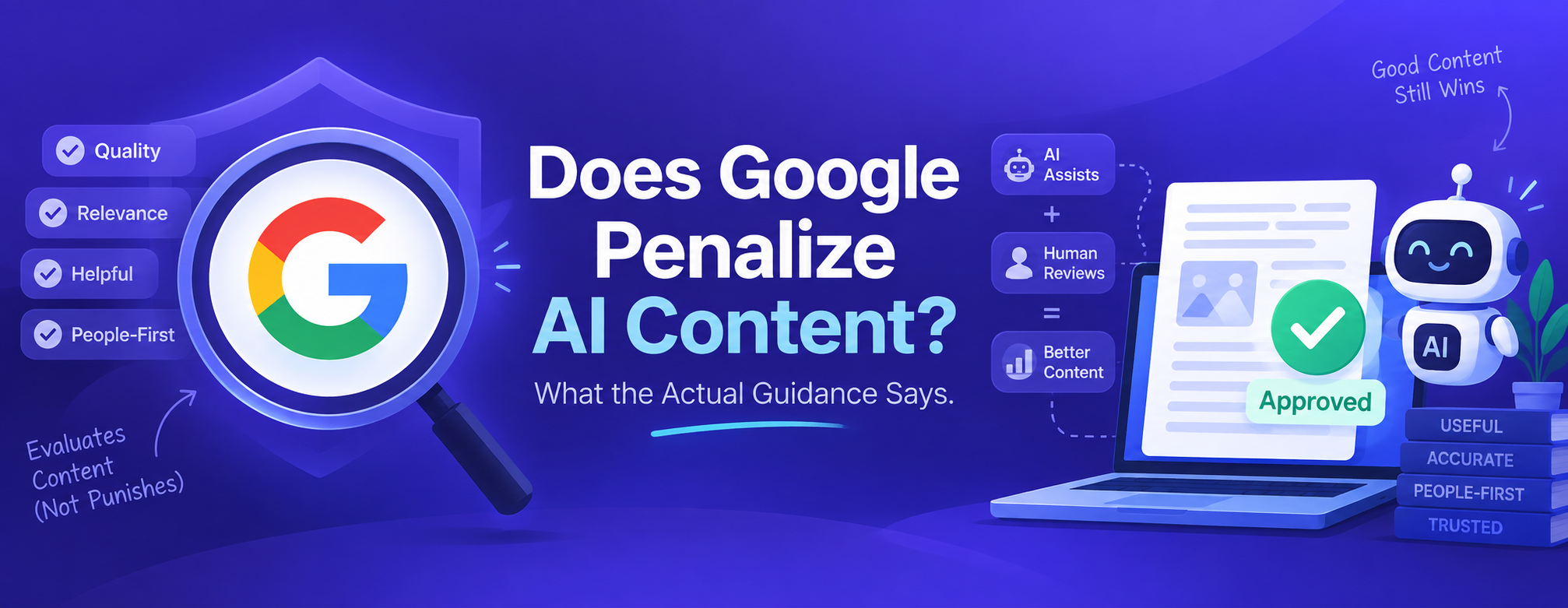
Type “does Google penalize AI-generated content” into a search bar and you’ll find years of conflicting takes: agencies claiming any AI content tanks rankings, others insisting Google can’t tell the difference at all. Neither is accurate, and Google has said so directly more than once since 2023.
This post goes straight to Google’s own documentation rather than secondhand summaries, breaks down what the guidance actually says, and separates the real risk (scaled, low-value content) from the myth (AI involvement itself).
Table of contents
Key takeaways
- Google has published official guidance on AI content since February 2023, and the position hasn’t changed since: using automation, including AI, to generate content primarily to manipulate rankings is a spam violation, but AI-assisted content that’s genuinely helpful is not.
- Does Google penalize AI-generated content as a category? No. Google’s own documentation states that appropriate use of AI or automation is not against its guidelines.
- What gets penalized is scaled content abuse, which Google defines as content generated primarily to manipulate search rankings rather than help users, regardless of whether AI, scraping, or manual templating produced it.
- The practical takeaway isn’t “avoid AI” it’s “avoid low-effort content at scale,” which is exactly the gap a compliance-focused tool like Edysor is built to close.
What Google Has Actually Said, Directly
Google’s clearest statement on this came from its Search Central team in a dedicated blog post explaining how Search treats AI-generated content.
The core line has stayed the same since it was published: appropriate use of AI or automation is not against Google’s guidelines, and the standard has been consistent for years, well before generative AI tools existed in their current form (Google Search Central, 2023).
What violates the guidelines, in Google’s own words, is using automation, including AI, to generate content primarily to manipulate rankings, which the post explicitly calls a spam policy violation (Google Search Central, 2023). The distinction Google draws isn’t about the tool used to produce the content; it’s about the purpose behind producing it and the value it delivers once it exists.
The Policy That Actually Applies: Scaled Content Abuse
The specific rule that governs AI content sits inside Google’s spam policies under a category called scaled content abuse. Google defines this as content generated primarily to manipulate search rankings rather than help users, and it explicitly states this applies no matter how the content was created (Google Search Central, n.d.-a).
Google’s own examples of scaled content abuse include using generative AI tools to produce many pages without adding user value, scraping and lightly rewriting existing content, and stitching together material from other pages without adding anything new (Google Search Central, n.d.-a).
Notice what’s absent from that list: there’s no rule against AI-assisted writing, AI-assisted editing, or AI-assisted research. The policy targets volume without value, not the presence of a model in the workflow.
| Scenario | Policy Status | Why |
|---|---|---|
| Using AI to draft a well-researched, edited, original post | Not a violation | Adds real value regardless of how it was produced |
| Publishing hundreds of AI pages with no editing or added value | Scaled content abuse | Volume aimed at manipulating rankings, not helping users |
| Scraping and lightly rewriting competitor content | Scaled content abuse | Explicitly named in Google’s own examples, AI or not |
| Using AI to summarize weather, sports scores, or transcripts | Not a violation | Google cites automation for this kind of content as a long-standing, accepted practice |
Based on Google’s own spam policy documentation and 2023 Search Central guidance. Google’s guidance is not a ranking guarantee; it describes what avoids a policy violation.
Where E-E-A-T Fits In
Google’s guidance also points creators toward its established quality framework rather than a separate one for AI. The same 2023 announcement directs creators to evaluate content by who produced it, how it was produced, and why, tying AI content back to the existing E-E-A-T concept (experience, expertise, authoritativeness, and trustworthiness) rather than introducing new AI-specific criteria (Google Search Central, 2023).
Google’s Search Quality Raters guidelines go further, giving human raters specific sections for evaluating scaled content abuse and low-effort main content, which shape how Google’s ranking systems are tuned, even though individual rater scores don’t directly set any one page’s rank (Google Search Central, n.d.-b).
What this means in practice
There is no AI content detector sitting between your post and Google’s ranking systems deciding whether a human or a model wrote it. Google evaluates the same thing it always has: does this page genuinely help the person who searched for it, and is there a clear “who” behind it?
Where Edysor Fits Into This
Google’s distinction between helpful AI-assisted content and scaled low-value content is the exact line Edysor’s content pipeline is built around.
Rather than generating a full post and publishing it unedited, Edysor’s compliance pass and per-section editing approach keep drafts closer to the “helpful, edited, original” side of that line before a human ever reviews them.
You can see how that pipeline works on the how it works page, and what the compliance checks specifically cover on the compliance page.
None of that replaces editorial judgment, and Google’s guidance doesn’t offer a shortcut around needing one. But it does mean the starting draft avoids the patterns Google’s own scaled content abuse policy names directly, rather than optimizing purely for output volume.
FAQ
The Tool Was Never the Issue
Google has been saying the same thing since 2023: it doesn’t penalize AI-generated content for being AI-generated, it penalizes content, AI-assisted or not, that’s published at scale with little value to the person reading it. That’s a much narrower target than most “AI content is risky” claims suggest.
Edysor’s compliance pass and per-section editing model are built around that same distinction.
If you want an AI blog writer for WordPress designed to stay on the helpful side of Google’s own guidance, you can get started at edysor.com.
See what one credit produces
One credit is one finished post, with a compliance and editing pass built in.
References
- Google Search Central. (2023, February 8). Google Search’s guidance about AI-generated content. Google for Developers. developers.google.com/search/blog/2023/02/google-search-and-ai-content
- Google Search Central. (n.d.-a). Spam policies for Google web search. Google for Developers. Retrieved 2026. developers.google.com/search/docs/essentials/spam-policies
- Google Search Central. (n.d.-b). Google Search’s guidance on using generative AI content on your website. Google for Developers. Retrieved 2026. developers.google.com/search/docs/fundamentals/using-gen-ai-content