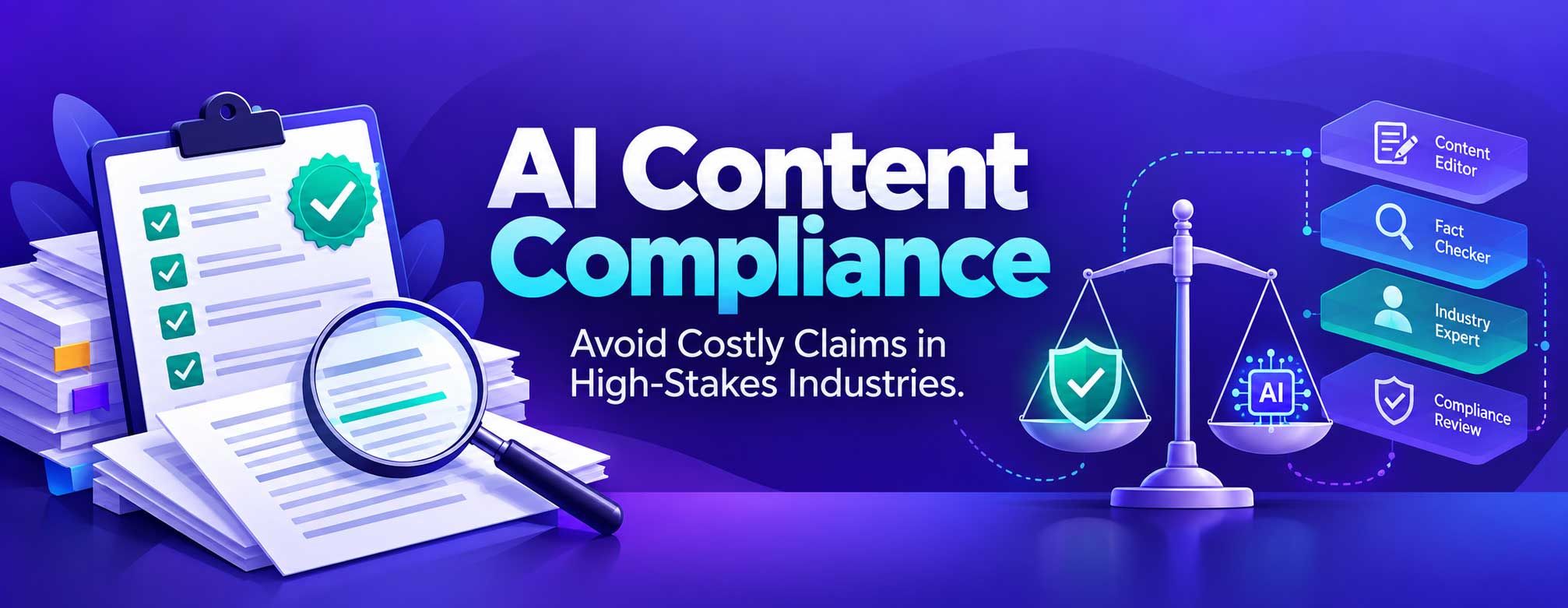
AI can draft a blog post in minutes, but it cannot be held accountable for what that post says. You can. In healthcare, finance, legal services and other regulated fields, one inaccurate sentence can trigger a regulator, a lawsuit or a lost client. That is why AI content compliance has become a core part of publishing, not an afterthought, especially for teams that publish at volume. This guide explains the risks, the enforcement record and a practical process for keeping AI-assisted content accurate, defensible and safe to publish.
Table of contents
- Why AI Content Compliance Matters More in High-Stakes Industries
- What the Enforcement Record Shows
- The Main AI Content Risks
- How to Ensure AI Content Compliance: Seven Steps
- Three Approaches to AI Publishing Compared
- AI Content Verification Techniques That Work
- Building AI Content Governance for Teams and Agencies
- Applying EEAT to Regulated Topics
- Compliance, Google and AI Detectors
- Choosing Tools and Planning the Budget
- Common Mistakes to Avoid
- Conclusion
- Frequently Asked Questions
Key takeaways
- Publishers, not AI tools, are responsible for claims that appear on their sites.
- Regulators judge content by substance and evidence, not by how it was written.
- A repeatable verification workflow prevents most costly mistakes.
- Higher-risk topics need subject-matter and compliance review before publishing.
Why AI Content Compliance Matters More in High-Stakes Industries
Language models predict plausible text. They do not check facts. This produces fluent but wrong statements, often called hallucinations, including invented statistics, outdated rules and fabricated sources. In a lifestyle blog, that is embarrassing. In a regulated industry, it can become a compliance failure.
Three factors raise the stakes. First, readers act on advice about money, health and legal rights. Second, regulators expect claims to be substantiated. Third, published content creates a lasting record that opponents can quote. AI-generated content compliance therefore means treating every draft as unverified until a person confirms it.
For businesses like Edysor, maintaining AI content compliance is especially important when publishing AI-generated content that users may rely on for accurate, trustworthy information.
What the Enforcement Record Shows
Several well-documented cases show how quickly unverified claims become expensive:
- Mata v. Avianca (2023). Lawyers filed a brief containing case citations generated by ChatGPT that did not exist. The court sanctioned them, and the attorney had even asked the chatbot to confirm the cases were real.
- SEC AI-washing actions (2024). On March 18, 2024, the SEC announced settled charges against two investment advisers, Delphia and Global Predictions, over false statements about their use of AI. Penalties were $225,000 and $175,000.
- FTC Operation AI Comply (2024). In September 2024, the FTC announced actions against five companies for deceptive AI-related conduct, using existing consumer protection law.
The SEC and FTC cases concern claims about AI rather than AI-written copy, but the lesson transfers. Regulators apply existing rules on deception and substantiation. Enforcement priorities can shift, yet the underlying duty to support your claims does not.
The Main AI Content Risks
Understanding AI content risks helps you decide where to place human attention. The most common problems are:
- Fabricated facts and citations. Sources or statistics that sound real but are not.
- Outdated information. Rules, prices and guidance that changed after the model’s training.
- Unsupported claims. Promises such as “guaranteed results” with no evidence.
- Missing disclosures. Omitted risk warnings, disclaimers or required language.
- Overconfident tone. Advice presented as certain when professionals would hedge.
Each risk is manageable once it is named. The table below shows how these problems appear in different industries, and who should review them.
| Industry | Typical Risky Claim | Standard to Check | Review Owner |
|---|---|---|---|
| Healthcare and wellness | Cure or treatment claims | Scientific evidence and advertising rules | Clinician or medical reviewer |
| Finance and investing | Returns or performance promises | Securities marketing rules | Compliance officer |
| Legal services | Case law and rule citations | Primary sources and court rules | Licensed attorney |
| Software and security | Capability or certification claims | Product facts and audit reports | Product or security lead |
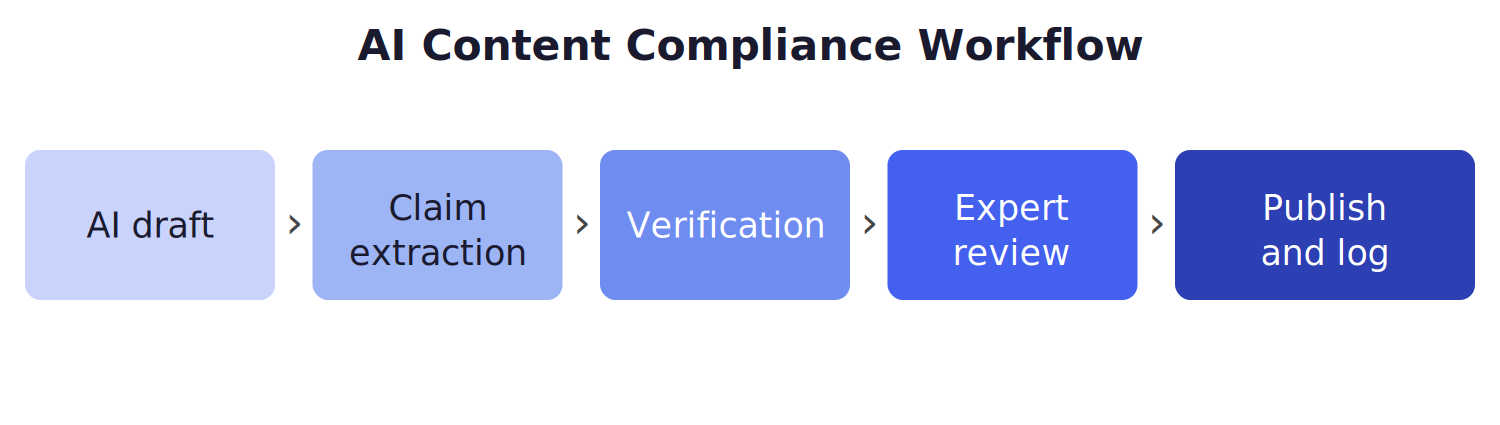
A repeatable workflow keeps AI drafts from reaching readers unchecked.
How to Ensure AI Content Compliance: Seven Steps
These AI content compliance best practices work for in-house teams and agencies alike. Start small, apply them to your riskiest pages first, and expand as the process becomes routine:
- Set risk tiers. Classify topics as low, medium or high risk, and assign review levels to each.
- Build an approved source library. Prefer regulators, standards bodies, peer-reviewed research and primary documents.
- Extract every claim. List each statistic, legal statement, product promise and comparison in the draft.
- Verify against primary sources. Open the original document, confirm the wording, and record the link and date.
- Add expert review. A qualified person signs off on high-risk material.
- Insert required disclosures. Add disclaimers, risk statements and authorship details.
- Log and refresh. Keep a record of approvals, and re-check content when rules change.
| Claim Type | Example | Verification Standard |
|---|---|---|
| Statistics | “Adoption grew 40%” | Original study, date and sample |
| Legal or regulatory | “Rule X requires Y” | Current text of the rule |
| Health or performance | “Reduces symptoms” | Credible evidence and expert sign-off |
| Product capability | “Integrates with Z” | Current product documentation |
| Testimonials | “Customers save hours” | Documented, genuine customer data |
Publish AI-Assisted Content With Confidence
Looking for a faster way to draft blog content that your team can then verify and approve? Explore Edysor and see how it fits your publishing workflow.
Three Approaches to AI Publishing Compared
Not every team manages risk the same way. The table below compares common approaches, from the riskiest to the most defensible.
| Factor | Ungoverned AI Drafting | Light Spot-Checking | Governed Workflow |
|---|---|---|---|
| Claim verification | None | Some claims only | Every claim logged |
| Source records | Absent | Informal notes | Linked and dated |
| Expert review | Rare | Occasional | Required for high risk |
| Audit trail | None | Partial | Complete |
| Compliance exposure | High | Medium | Lower |
AI Content Verification Techniques That Work
AI content verification is a habit, not a single tool. The most reliable techniques are simple:
- Never let the AI check itself. The Avianca lawyers asked the chatbot to confirm its own citations, which proved nothing.
- Trace every number to its source. If you cannot open the original, remove the statistic.
- Check dates. Confirm that laws, prices and guidance are current.
- Read for implied promises. Words such as “guaranteed” and “proven” need evidence.
- Use a second reviewer. A fresh reader spots errors the author missed.
Length also matters. Longer drafts contain more claims, and therefore more chances for error. Our analysis of whether AI can write a 3000-word blog post explains how quality and accuracy hold up at scale.
Building AI Content Governance for Teams and Agencies
AI content governance turns good intentions into a system. It defines who may use AI, for what, and who approves the result. A workable policy includes four elements:
- Roles. A writer, an editor, a subject-matter expert and a final approver.
- Rules. Which topics AI may draft and which require expert authorship.
- Records. Source notes, review dates and sign-offs stored with each post.
- Review cadence. Scheduled audits of older articles.
Scale increases the challenge. Agencies handling many accounts need consistent checks across every client, and our guide on how agencies can manage 10 client blogs without extra writers shows how process makes that possible.
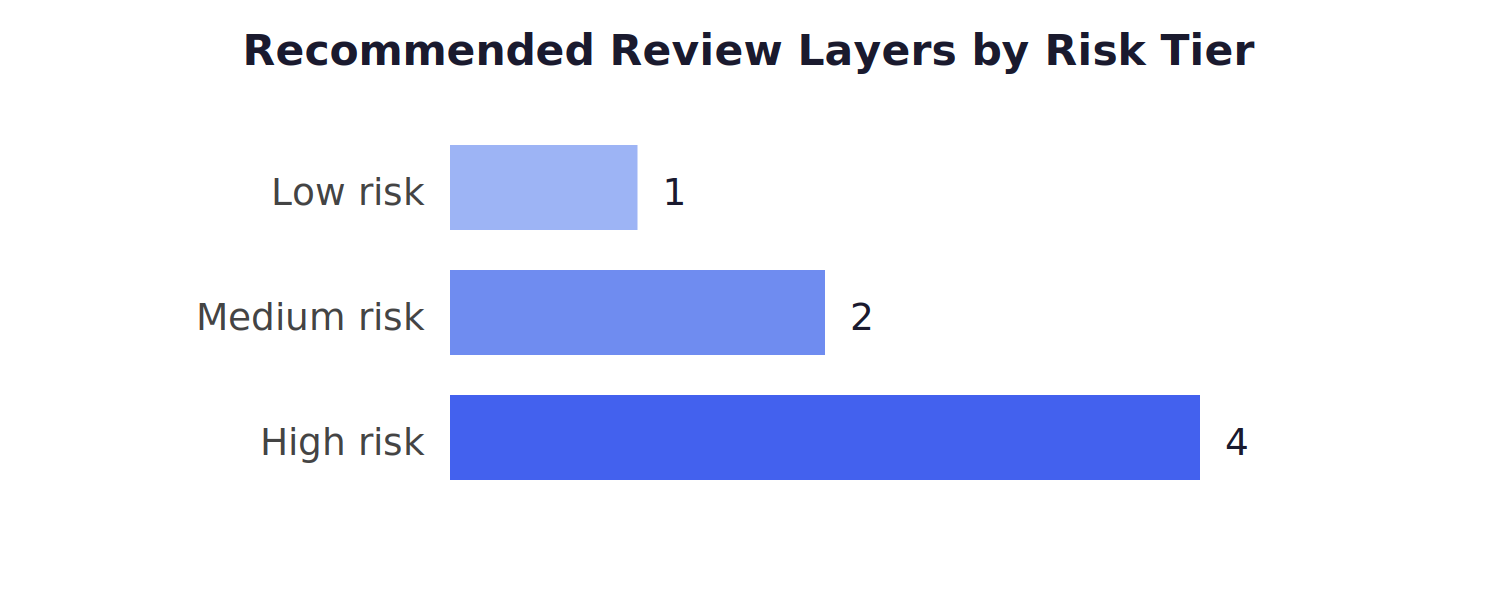
Editorial recommendation, not measured data. Layers might include editor, fact-checker, expert and compliance.
Applying EEAT to Regulated Topics
Search engines and AI assistants both favor content that shows experience, expertise, authoritativeness and trust. For regulated topics, that means more than good writing. Show who wrote and reviewed each article, list their credentials, cite primary sources, and display a clear update date. Readers and AI systems can then judge the reliability of the page before relying on it.
Practical steps include adding author and reviewer bylines, linking to official sources and explaining your editorial process on a dedicated page. These signals take little effort and make accountability visible.
Compliance, Google and AI Detectors
Many teams confuse compliance with avoiding detection. They have different goals. Accuracy and substantiation protect you from regulators and readers, while detection tools only look for stylistic patterns. Understanding why AI content gets detected is useful, but passing a detector does not make a claim true.
Search engines focus on quality as well. Google has said that it evaluates helpfulness and reliability rather than the method of production, and its guidance on scaled low-quality content still applies. Read what Google’s guidance says about AI-generated content for the details. For sensitive topics, expert authorship and clear sourcing support both rankings and trust.
Choosing Tools and Planning the Budget
Tools speed up drafting, but they do not remove review work. When comparing options, ask whether the platform supports source citation, editing workflows and exports that fit your CMS. If you publish on WordPress, compare AI blog writing plugins for WordPress against your approval process.
Budget for verification as well as generation. A cheap draft that needs heavy checking can cost more than expected, so review the per-post pricing of AI blog writers and add reviewer time to the total. High-risk posts may justify the cost of a specialist, because one prevented error can outweigh the fee many times over.
Common Mistakes to Avoid
Even careful teams repeat a few predictable errors:
- Trusting fluent text. Confident wording is not evidence.
- Skipping updates. Old articles can become inaccurate when rules change.
- Treating disclaimers as a shield. A disclaimer does not excuse a false claim.
- Sharing sensitive data. Avoid pasting confidential client or patient information into prompts.
Conclusion
AI makes publishing faster, but it does not make publishers less responsible. Strong AI content compliance rests on three habits: classify risk, verify every claim against primary sources, and keep records of who approved what. Teams that build these habits early can use AI confidently, even in regulated industries, while avoiding the expensive mistakes that make headlines.
Build a Safer AI Content Workflow
Ready to speed up drafting without skipping review? Visit Edysor to explore how AI-assisted blogging can work alongside your approval process.
Frequently Asked Questions
What is AI content compliance?
It is the practice of ensuring that AI-assisted content is accurate, substantiated and consistent with the laws, regulations and standards that apply to your industry. It combines verification, expert review and record keeping.
How do I prevent inaccurate AI claims?
Extract every factual claim from a draft, then verify each one against primary sources. Remove anything you cannot confirm, and never ask the AI tool to verify its own output. Keep a dated record of each check.
Do I have to disclose that content was written with AI?
Requirements vary by country, industry and platform. Some rules require disclosure in specific contexts, so check applicable regulations and consult legal counsel for your situation.
Does Google penalize AI-generated content?
Google has said it focuses on content quality and helpfulness rather than how content is produced. Low-quality content produced at scale can still violate its spam policies.
Who is responsible if AI content contains a false claim?
The publisher is generally responsible for what appears on its website, regardless of the tool used to draft it. That is why human review and documented approvals matter.