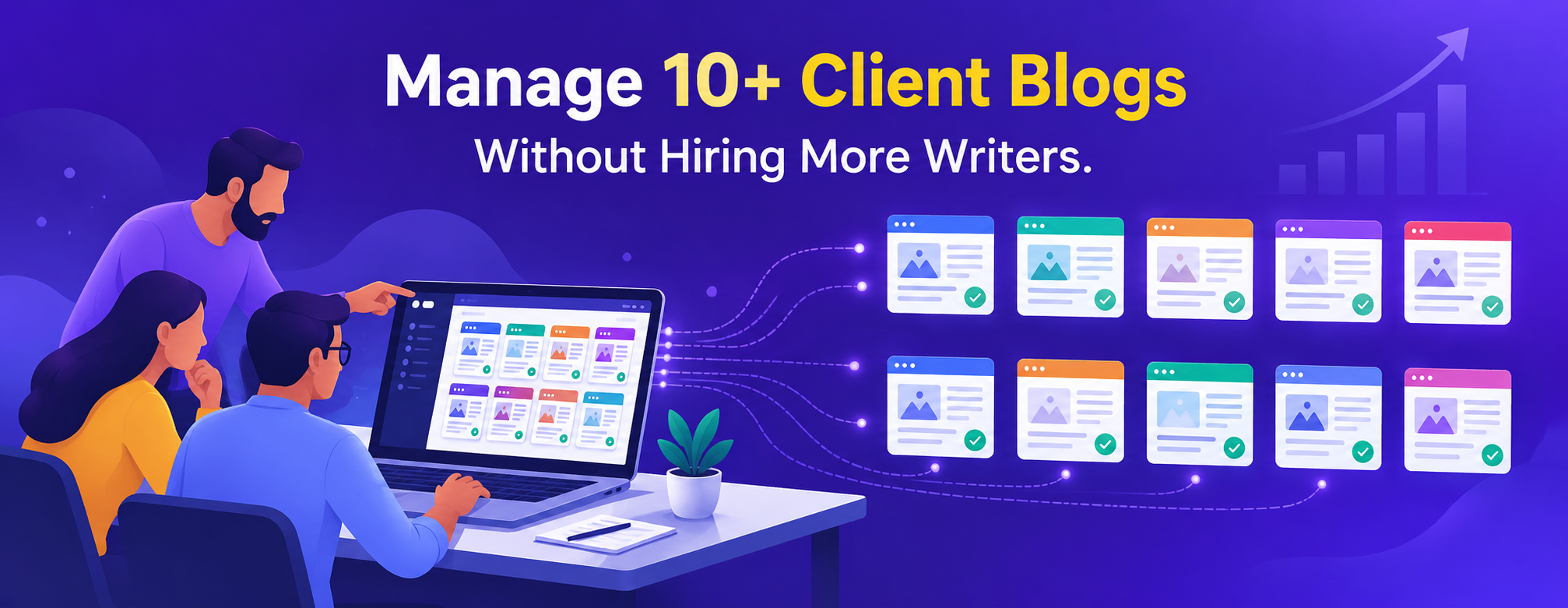
Most marketing agencies hit the same wall once they cross five or six retainer clients, the content calendar grows faster than the writing bench. Bringing on another full-time writer for every two or three new accounts is not a scalable model, which is why more agencies are restructuring their editorial process around AI-assisted blog writing plugins for WordPress instead of headcount. This article breaks down exactly how a lean agency team can run 10, 15, or even 20 client blogs at once, without sacrificing quality, EEAT compliance, or search visibility.
For agencies handling multiple accounts, the key to efficiency is having a structured content workflow that allows teams to manage multiple client blogs without sacrificing quality or consistency. By using centralized content calendars, standardized briefs, AI-assisted research, reusable templates, and streamlined review processes, agencies can increase publishing capacity while keeping each client’s brand voice, SEO goals, and content strategy aligned.
Table of contents
- The Client Blog Scaling Problem
- What Changes Internally When an Agency Adopts This Model
- Why Hiring More Writers Doesn’t Scale
- The AI-Assisted Agency Workflow, Step by Step
- Building an EEAT-Compliant Workflow Across Every Client Blog
- Choosing the Right AI Blog Writing Plugin for Multi-Client WordPress Management
- Cost Breakdown: What Per-Post Pricing Looks Like at Scale
- Avoiding AI Detection Flags Across Every Client Account
- AI Content Generator vs. AI Content Automation — Which Fits an Agency?
- Frequently Asked Questions
Key takeaways
- Use AI-assisted workflows to scale content production — Agencies can manage 10+ client blogs more efficiently by combining AI-generated drafts with human editing and strategic oversight.
- Standardize the content process across clients — A repeatable workflow covering keyword research, drafting, editorial review, formatting, internal linking, and performance tracking helps maintain consistency at scale.
- Keep humans involved for EEAT and quality control — AI should handle repetitive production tasks, while editors verify facts, add first-hand insights, maintain brand voice, and strengthen EEAT signals.
- Create client-specific brand and SEO profiles — Maintaining each client’s brand voice, keywords, internal-linking targets, and content requirements prevents generic content and makes multi-client management more consistent.
- Test the workflow before scaling it across all accounts — A practical approach is to pilot the AI-assisted process on one or two client accounts, measure rankings and traffic, and use the results to refine the workflow before wider adoption.
The Client Blog Scaling Problem
Every agency owner has run the math at some point. A single experienced content writer can realistically research, draft, and edit two to three high-quality 1,500-word posts per week. If each client needs four posts a month, one writer can properly service two, maybe three accounts before quality starts slipping. Scale that to ten clients and you are looking at three to four full-time salaries just for blog production, before touching outreach, technical SEO, or reporting.
The problem compounds because client expectations rarely shrink as the roster grows. Each account still wants its own tone of voice, its own keyword targets, and its own publishing cadence. Hiring linearly against client growth is what keeps agency margins thin, and it’s the exact bottleneck that AI-assisted workflows were built to remove.
There’s also a seasonality problem that pure headcount doesn’t solve well. Client demand for content isn’t flat, a product launch, a seasonal promotion, or a sudden algorithm update can triple the number of posts a client needs in a single month, then drop back down. A fixed writing staff is either overstaffed in slow months or completely underwater during a spike, and freelance contractors introduce their own onboarding lag right when speed matters most. An AI-assisted pipeline absorbs that variability far more gracefully, since output capacity isn’t tied to how many people are on payroll that quarter.
What Changes Internally When an Agency Adopts This Model
The shift isn’t just about tooling, it changes what the content team actually does day to day. Writers who used to spend 80% of their time drafting shift toward research, fact-checking, and strategic editing, which is a higher-leverage use of a skilled writer’s time. Account managers get more predictable turnaround times to quote clients, since output is no longer bottlenecked by an individual writer’s calendar. And onboarding a new client account becomes a matter of building a brand voice profile and keyword list, rather than waiting weeks for a new hire to reach full productivity.
This also changes how agencies price retainers. Instead of quoting based on writer-hours, many agencies are shifting to output-based pricing, a fixed number of posts per month at a fixed price, because the marginal cost of an additional post drops so much once the AI-assisted pipeline is in place. That pricing flexibility is itself a competitive advantage when pitching against agencies still staffed the old way.
Why Hiring More Writers Doesn’t Scale
Adding writers solves the volume problem for a while, but it introduces three new ones: onboarding time, style-consistency drift across accounts, and a fixed cost base that doesn’t flex when a client churns. A new hire typically needs four to six weeks to fully absorb a client’s brand voice and SEO guidelines before their output needs minimal editing.
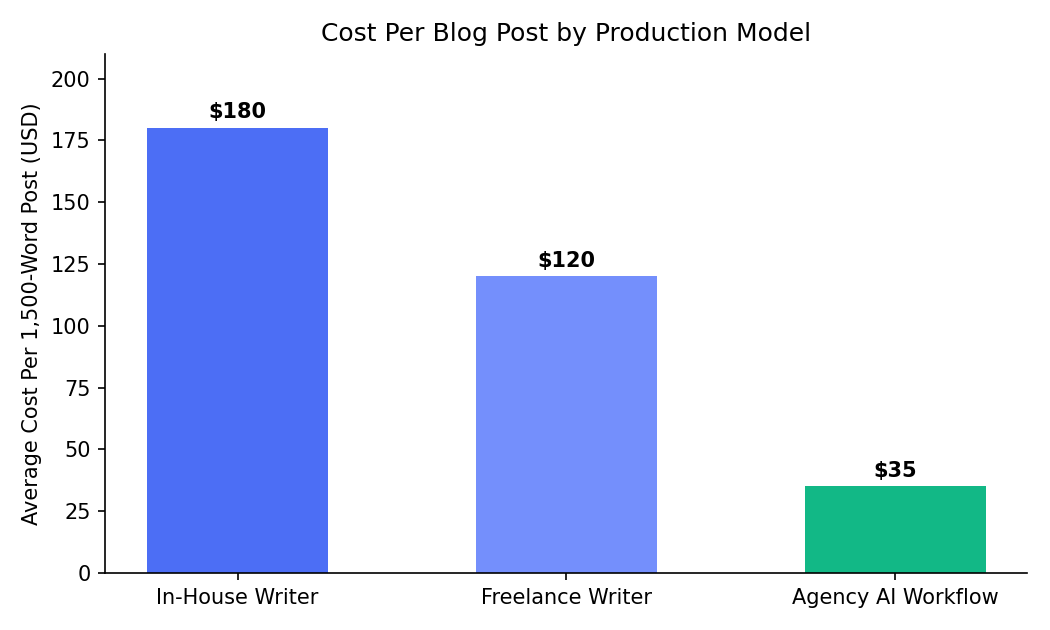
Figure 1: Average cost per 1,500-word blog post by production model.
The gap in Figure 1 is the reason so many agencies are re-architecting production around AI tooling rather than adding desks. An AI-assisted workflow, where a plugin like Edysor handles the first draft, keyword mapping, and internal linking, and a human editor reviews for accuracy and brand fit, collapses cost per post by roughly 70–80% compared to a fully manual writer, while still keeping a human in the loop for quality control.
The AI-Assisted Agency Workflow, Step by Step
A repeatable multi-client workflow generally has five stages:
- Keyword and topic clustering per client, pulled from GSC and competitor gaps
- AI-generated first draft with brand voice guidelines and internal link targets fed in as inputs
- Human editorial pass for factual accuracy, EEAT signals, and tone
- Automated formatting, schema, and internal linking before publish
- Performance tracking (rankings, AI Overview citations, traffic) fed back into the next topic cluster
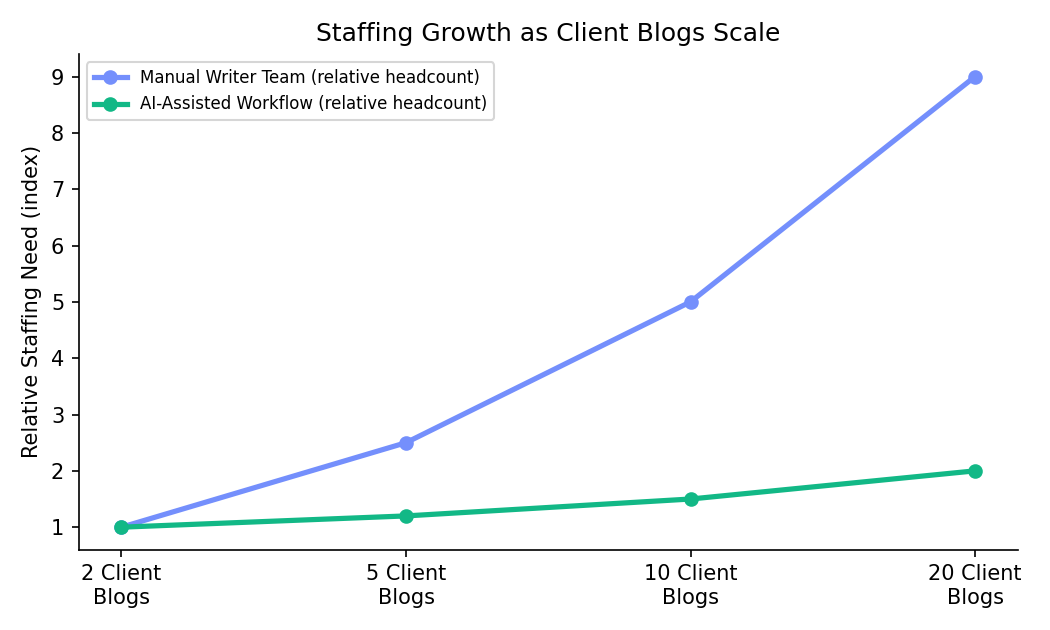
Figure 2: Relative staffing needs as client blog count scales, manual vs. AI-assisted.
As Figure 2 shows, a manual writing team’s headcount needs rise almost linearly with client count. An AI-assisted workflow flattens that curve significantly, because the editorial team’s job shifts from writing every word to reviewing and directing, a task that scales far better per person.
| Factor | Traditional Hiring Model | AI-Augmented Model |
|---|---|---|
| Cost per post | $120–$180 | $25–$45 |
| Time to first draft | 2–4 days | 10–20 minutes |
| Scalability past 10 clients | Requires new hires | Same team, more output |
| Consistency across accounts | Varies by writer | Template-driven, consistent |
| Onboarding time per client | 4–6 weeks | Same day, via brand profile |
Building an EEAT-Compliant Workflow Across Every Client Blog
Scaling output only matters if the content still ranks. Google’s guidance on AI-assisted writing is more nuanced than agencies often assume, and it’s worth reading the specifics on whether Google actually penalizes AI-generated content before rolling this out across every account. In short: the search engine evaluates content quality and demonstrated expertise, not the tool used to produce the first draft.
Practically, that means every client blog needs a visible author with real credentials, original data or examples where possible, and a human edit pass that adds first-hand insight the AI draft couldn’t generate on its own. Agencies that skip the editorial layer and publish raw AI output are the ones who see ranking volatility — not because AI was involved, but because the EEAT signals were missing.
For agencies managing many accounts at once, the practical fix is a per-client EEAT checklist applied before anything goes live: a named author bio linked to a real profile, at least one original data point, screenshot, or client-specific example per post, and a final read for factual accuracy against the client’s actual products or services. Building this checklist into the publishing workflow, rather than treating it as an afterthought, is what lets a small editorial team maintain quality across ten or more accounts without each one needing a dedicated specialist.
Choosing the Right AI Blog Writing Plugin for Multi-Client WordPress Management
Most agency clients run on WordPress, which makes plugin choice the single biggest lever in this workflow. A detailed side-by-side of the best AI blog writing plugins for WordPress in 2026 is worth reviewing before committing, but the shortlist criteria for agency use are consistent: multi-site support, brand voice profiles per client, built-in internal linking, and native FAQ/schema generation so every post is AI Overview-eligible out of the box.
A plugin that can be configured once per client and then run on autopilot for scheduled publishing is what actually removes the writer bottleneck, versus a generic AI writer that still requires manual copy-pasting into WordPress for every single post.
Cost Breakdown: What Per-Post Pricing Looks Like at Scale
Agencies pricing this out for the first time should look at the full per-post pricing breakdown for AI blog writers, since costs vary by word count, image generation, and whether internal linking and schema are included. At 10 client blogs producing 4 posts a month each, 40 posts monthly, the cost delta between a manual and AI-assisted model typically runs into several thousand dollars a month, which is margin an agency can either keep or reinvest in strategy and reporting.
Avoiding AI Detection Flags Across Every Client Account
Running dozens of client blogs through the same AI pipeline raises a fair question: will the content read as templated or get flagged by detectors? The patterns that AI detectors actually look for are usually structural — repetitive sentence rhythm, generic transitions, and a lack of specific, verifiable detail — not the use of AI itself. Feeding each client’s real data, case studies, and product specifics into the draft, then editing for natural variation, is what keeps content across a large client roster from reading as interchangeable.
AI Content Generator vs. AI Content Automation — Which Fits an Agency?
It’s worth being precise about terminology when evaluating tools, since the difference between an AI content generator and full AI content automation changes what an agency can actually offload. A generator produces text you still have to place, format, and publish manually. Automation handles the keyword research, drafting, internal linking, formatting, and scheduled publishing end-to-end — which is the layer that actually removes hiring pressure at scale.
Ready to see this workflow in action?
Explore how Edysor automates blog production for agency clients.
Comparison Table: AI Content Generator vs. AI Content Automation
| Capability | AI Content Generator | AI Content Automation (Edysor) |
|---|---|---|
| Drafts blog copy | Yes | Yes |
| Keyword & topic research | Manual | Built-in |
| Internal linking | Manual | Automated |
| Publishes to WordPress | No — copy/paste | Direct publish/schedule |
| Multi-client brand profiles | No | Yes |
| FAQ / schema generation | No | Yes |
Frequently Asked Questions
Can AI-written blogs actually rank on Google for client SEO campaigns?
Yes, provided the content meets EEAT standards, a credible author, accurate information, and a human editorial pass. Google’s own guidance focuses on quality signals, not the production method, so agencies that keep humans in the review loop see normal ranking performance.
How many client blogs can one editor manage with an AI-assisted workflow?
Most agencies find one editor can oversee 8–12 client accounts when AI handles the first draft, keyword mapping, and formatting, compared to 2–3 accounts under a fully manual writing model.
Will switching to AI content automation upset existing clients?
Not if quality and voice consistency are maintained. Most clients care about results and turnaround time, not the drafting method, as long as the agency retains editorial oversight and brand accuracy.
Does using an AI plugin across multiple WordPress sites cause duplicate content issues?
No, as long as each client’s content is generated from that client’s own keyword research and brand inputs. Duplicate content risk comes from copying structure or phrasing verbatim across sites, not from using the same underlying tool.
What’s the fastest way to test this workflow before rolling it out agency-wide?
Pilot the workflow on one or two lower-stakes client accounts for a full month, track rankings and traffic against the previous manual baseline, and use that data to decide whether to migrate the rest of the roster.
See exactly how the plugin handles multi-client publishing. Compare the top AI blog writing plugins for WordPress →