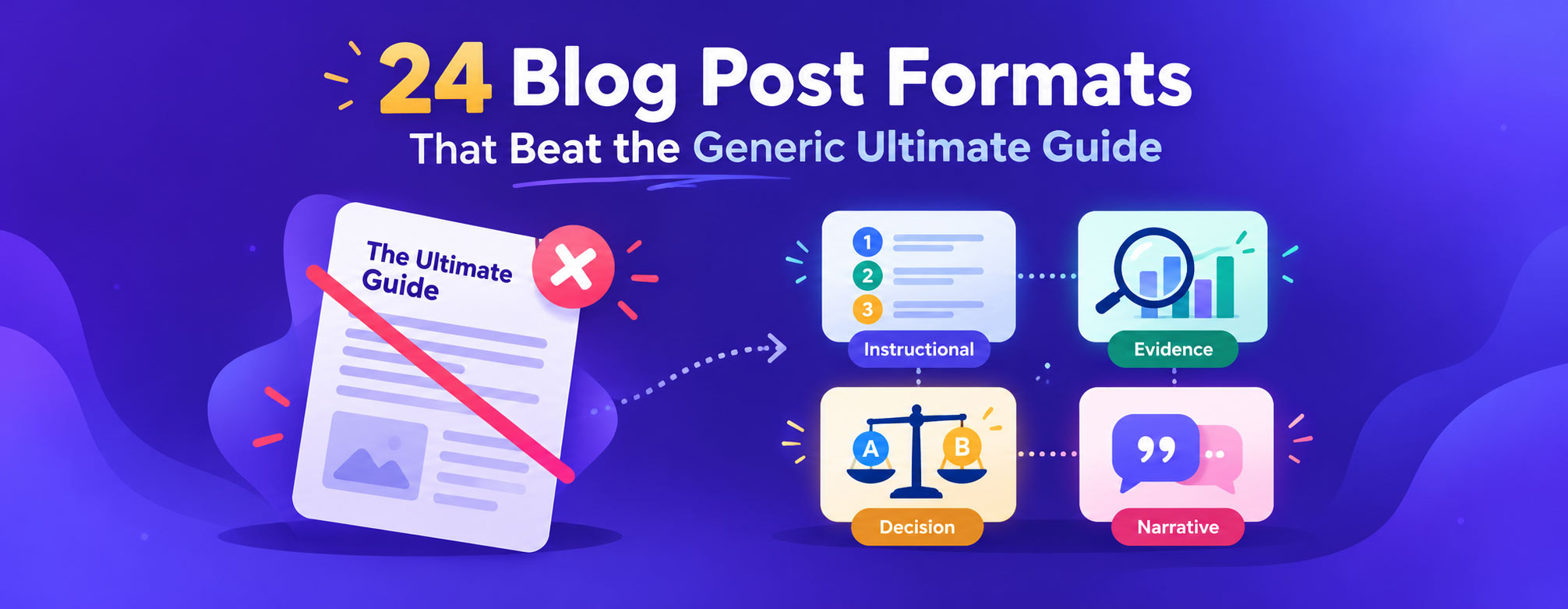
Every content team eventually hits the same wall: another 5,000-word “ultimate guide” that competitors already published, and readers already skimmed. The fix is not more words. It is choosing better blog post formats.
Key takeaways
- Choose the Right Blog Format: Match your blog post format with search intent. Tutorials answer informational queries, comparisons help decision-making, and original research builds credibility.
- Prioritize Originality Over Length: Focused, experience-driven content provides more value than generic ultimate guides. Every section should address a specific reader need.
- Use Four Content Format Families: Combine instructional, evidence-based, decision-making, and narrative formats to improve SEO performance, engagement, and reader trust.
- Leverage AI While Maintaining Human Expertise: Use AI to accelerate outlines, structured drafts, FAQs, and comparisons, while adding original research, real-world experience, and fact-checked information.
- Measure Performance Based on Content Goals: Track organic clicks for instructional posts, backlinks for evidence-based content, conversions for decision posts, and returning visitors for narrative content. Optimize your strategy based on actual results.
This guide covers 24 formats, when each one works, and how SI (Super Intelligence) can speed up drafting while your team adds the experience that earns trust. If you wonder whether long-form still matters, see whether AI can write a 3,000-word blog post well, then use the formats below to decide when it should.
Table of contents
- Quick Answer: Which Blog Post Formats Work Best?
- Why the Generic Ultimate Guide Keeps Failing
- Instructional Formats
- Evidence Formats
- Decision Formats
- Narrative and Engagement Formats
- Blog Post Formats Compared
- Illustrative Engagement Potential by Format Family
- How to Choose the Right Blog Post Format
- Using SI (Super Intelligence) Without Losing Trust
- Illustrative Production Effort by Format Family
- Examples of Effective Formats in Practice
- How to Structure Posts for Readability and Rankings
- How to Measure Which Format Works
- Making Every Format Trustworthy
- A Sample Quarterly Format Mix
- Format Trends to Watch in 2026
- Common Format Mistakes
- Final Thoughts
- Frequently Asked Questions
Quick Answer: Which Blog Post Formats Work Best?
The best blog post format is the one that matches search intent. Instructional formats win informational queries, evidence formats earn citations and links, decision formats convert comparison shoppers, and narrative formats build loyalty. Most strong content strategies rotate across all four families instead of repeating one template.
Why the Generic Ultimate Guide Keeps Failing
Ultimate guides try to answer everything, so they rarely answer one question better than a focused page. They also look alike. Google’s people-first content guidance asks whether your page offers original value beyond what already exists, and a recycled mega-guide usually does not. Recent coverage of Google’s updated helpful content documentation, such as this Search Engine Journal analysis, highlights main content and originality as central ideas. A format built around a real purpose satisfies both. That does not mean long content is wrong. A long page works when every section earns its place, such as a deep tutorial or a research report. Length should follow the question, never the other way round.
The 24 Blog Post Formats
Instructional Formats
Instructional formats answer “how” and “what do I do” questions, which makes them the backbone of most organic traffic strategies.
- How-to tutorial: Step-by-step instructions that solve one task. Use numbered steps, screenshots and a clear outcome, and these posts match high-intent searches closely.
- Checklist: A scannable list of actions readers can complete and tick off. Checklists work well for audits, launches and recurring routines.
- Template or swipe file: Ready-made frameworks readers copy into their own work. Offer the template inside the post so the value arrives immediately.
- Troubleshooting guide: A symptom-first post that diagnoses a problem and explains the fix. Lead with the error or complaint exactly as people search it.
- Beginner’s roadmap: A staged learning path from first steps to advanced practice. It suits broad topics where newcomers feel lost.
- FAQ hub: Direct question-and-answer pages suited to featured snippets and LLM citations. Keep each answer short, factual and self-contained.
Evidence Formats
Evidence formats prove claims. They take longer to produce, but they earn links, mentions and AI citations that generic guides rarely attract.
- Case study: A real project told through problem, method and measured result. Include constraints and what did not work, because honesty builds credibility.
- Original research: Surveys or datasets you collect yourself. Because nobody else owns the numbers, other writers have to cite you.
- Data roundup: Statistics gathered from primary sources, with dates and context. Never repeat a figure you cannot trace to its origin.
- Experiment recap: A test with a hypothesis, setup and honest outcome, failures included. Readers trust writers who report negative results.
- Benchmark report: Side-by-side measurements of tools or methods under identical conditions. Publish your method so others can verify it.
- Expert interview: A Q&A with a named practitioner who adds credentials you lack. Prepare specific questions and credit the expert clearly.
Decision Formats
Decision formats serve readers who are ready to choose. They sit close to revenue, so accuracy and fairness matter more than enthusiasm.
- Comparison post: X versus Y, judged on criteria readers actually care about. Use a table and state who each option suits.
- Alternatives roundup: Options for people leaving a tool, with clear fit guidance. Explain the reason someone might switch.
- Buyer’s guide: Criteria, red flags and recommendations for a specific purchase. Define what “good” looks like before naming products.
- Pros and cons review: A balanced verdict from hands-on use. Include limitations even when you recommend the product.
- Decision tree: Branching questions that lead readers to the right choice. It reduces choice overload and keeps visitors on the page.
- Pricing breakdown: Transparent cost ranges and the factors that drive them. Pricing questions are common, and few sites answer them candidly.
Narrative and Engagement Formats
Narrative formats build recognition and loyalty. They rely on voice and experience, which is exactly what machines cannot imitate.
- Thought leadership opinion: A reasoned position backed by evidence and experience. Take a clear stance and explain the trade-offs.
- Behind-the-scenes process: How your team really produces something, shown step by step. It demonstrates transparency and first-hand expertise.
- Myth-busting post: Common misconceptions corrected with sources. Quote the myth as readers phrase it, then correct it briefly.
- Before-and-after teardown: A weak page or process improved, with each change explained. Visual comparisons make the lesson memorable.
- Trend forecast: Informed predictions, with the reasoning shown. Label opinion as opinion and revisit forecasts when the year ends.
- Lessons-learned post: Mistakes made, what they cost and what changed afterwards. Vulnerability paired with specifics earns attention.
Blog Post Formats Compared
Use this table to match format families to goals and effort.
| Format Family | Best For | SEO Strength | Effort | Trust Signal |
|---|---|---|---|---|
| Instructional | Informational queries | High | Medium | Practical accuracy |
| Evidence | Backlinks and citations | Very high | High | Original data |
| Decision | Commercial intent | High | Medium | Honest comparison |
| Narrative | Loyalty and shares | Medium | Low to medium | First-hand voice |
Illustrative Engagement Potential by Format Family
| Format family | Score (0–100) | Bar |
|---|---|---|
| Evidence formats | 90 | |
| Narrative formats | 80 | |
| Decision formats | 75 | |
| Instructional formats | 70 |
Illustrative editorial framework, not measured data.
How to Choose the Right Blog Post Format
Start with the reader’s question, not your template. Ask four things: what does the searcher want to do, what stage are they in, what proof can you offer, and how much time does production need? Then map the answers. State the purpose of each post in its first paragraph so readers know immediately what they will gain here.
| Reader Goal | Best Format | Example Trigger |
|---|---|---|
| Learn a task | How-to tutorial | “how to” queries |
| Pick a tool | Comparison post | “X vs Y” queries |
| Check a claim | Myth-busting post | “is it true” queries |
| Trust a provider | Case study | “results” or “reviews” queries |
A Steady Supply of Varied, SEO-Friendly Posts
Try Edysor to generate structured drafts inside WordPress, then add your own experience before publishing.
Using SI (Super Intelligence) Without Losing Trust
SI is excellent at structure: outlines, tables, FAQs and first drafts for instructional and decision formats. It cannot supply lived experience, so evidence and narrative formats need human input. Review why AI content gets detected to avoid repetitive phrasing, and compare tools in this overview of AI writing plugins in 2026.
Agencies face an extra challenge: variety at volume. Rotating formats across accounts is one reason teams can manage 10 client blogs without hiring more writers.
Illustrative Production Effort by Format Family
| Format family | Score (0–100) | Bar |
|---|---|---|
| Evidence formats | 90 | |
| Decision formats | 60 | |
| Instructional formats | 50 | |
| Narrative formats | 40 |
Illustrative editorial framework, not measured data.
Examples of Effective Formats in Practice
Consider a project management software company. Its generic guide, “The Ultimate Guide to Project Management,” competes with thousands of near-identical pages. Replace it with a cluster: a how-to tutorial on building a sprint plan, a comparison post on two planning methods, a case study from a real client rollout, and a myth-busting post about common estimation errors. Each page targets one intent, links to the others, and offers something specific that the generic guide cannot.
A local services business can follow the same logic. A pricing breakdown answers the question customers ask first, a before-and-after teardown shows quality, and a lessons-learned post explains how the team improved its process. These formats feel human because they are built from real work.
How to Structure Posts for Readability and Rankings
Format is only half the job. Within any format, apply the same readability rules. Put the answer in the first two sentences, then expand. Use descriptive subheadings that mirror real questions. Keep paragraphs to three or four lines, and break up dense sections with tables, lists or diagrams. Add alt text to visuals, and write link anchors that describe the destination.
Search systems and language models both prefer extractable structure. A clear heading followed by a direct answer is easy to quote, which increases the chance of appearing in AI summaries. Add FAQ schema where the page truly contains questions and answers, and keep your author information consistent across the site.
How to Measure Which Format Works
Track each format against the goal it was chosen for, not against a single traffic number. Instructional posts should be judged on impressions, clicks and time on page. Evidence posts should be judged on backlinks and citations. Decision posts should be judged on conversions, and narrative posts on returning readers and shares.
| Format Family | Primary Metric | Secondary Metric |
|---|---|---|
| Instructional | Organic clicks | Scroll depth |
| Evidence | Referring domains | Branded searches |
| Decision | Conversion rate | Assisted conversions |
| Narrative | Returning visitors | Social shares |
Google Search Console shows which queries each page earns, so compare pages within the same family before drawing conclusions. Give new posts a few months before judging them, because rankings and citations build gradually.
Making Every Format Trustworthy
E-E-A-T applies to every format, not only expert content. Add a named author, cite primary sources, show first-hand evidence, and note how SI assisted the draft. Update statistics regularly and display the review date. These habits help readers, and they give language models clean, attributable facts to quote.
A Sample Quarterly Format Mix
Variety works best when it is planned. The table below shows a simple rotation for a team publishing twelve posts a quarter.
| Month | Instructional | Evidence | Decision | Narrative |
|---|---|---|---|---|
| Month 1 | 2 posts | 1 post | 1 post | 0 posts |
| Month 2 | 1 post | 1 post | 1 post | 1 post |
| Month 3 | 1 post | 1 post | 0 posts | 2 posts |
Review performance at the end of the quarter. Keep formats that earn clicks, citations or conversions, and retire those that only add volume.
Format Trends to Watch in 2026
Three shifts are changing how formats perform. First, readers expect direct answers, so posts that open with the conclusion hold attention longer. Second, generative search summarizes sources, which rewards structured formats such as FAQs, comparisons and data tables. Third, originality matters more as SI-assisted content becomes common, so evidence and narrative formats gain value because they rely on proof only your team can provide.
The practical response is balance. Use SI for speed on structured formats, protect time for original research and storytelling, and keep every page accountable to a named author.
Common Format Mistakes
- Forcing a listicle onto a topic that needs a tutorial
- Publishing identical structures across every post
- Skipping original evidence in case studies
- Hiding the answer below long introductions
- Ignoring mobile readability, such as long paragraphs and wide tables
Final Thoughts
Strong blog post formats give readers a reason to choose your page over another ultimate guide. Pick the format that fits the question, let SI handle structure, and let people supply proof. Start by auditing your ten best pages and relabel each with its format family. Then choose one format you have never tried, publish it this month, and compare the results with your usual template.
Publish More Formats, Faster
Explore Edysor and build a consistent, reviewable blog workflow in WordPress.
Frequently Asked Questions
What are the best blog post formats for SEO?
How-to tutorials, comparison posts, FAQ hubs and original research perform well because they match clear search intent and attract citations.
How do I choose the right blog post format?
Match the format to the reader’s goal and stage. Learners need tutorials, buyers need comparisons, and skeptics need case studies or data.
Are ultimate guides still worth writing?
Yes, when they offer unique value and strong structure. A guide with no original angle competes poorly against focused, experience-led formats.
How can I make blog posts more engaging?
Open with the answer, use short paragraphs, add tables and visuals, and include real examples from your own work.
Can AI-generated content use these formats?
Yes. SI can draft structured formats quickly, but humans should add evidence, verify claims and disclose how the content was made.