
The difference between an AI content generator and AI content automation lies in the processes surrounding the writing. While a generator generally produces an output in response to a directive, an automation workflow links together a number of steps, including research, outlining, drafting, reviewing, formatting, and publishing so as to enable a content team to cut down on repetitive manual tasks.
For a business, an agency, or a WordPress publisher, the difference matters because increasing content volume does not equal creating useful content. This guide outlines the difference, shows where automation can fall short, emphasizes the continued need for human supervision, and explains how to assess an AI content process without assuming automation ensures good SEO performance.
Table of contents
- What “AI Content Generator” Actually Means
- What “AI Content Automation” Actually Means
- Where a Tool Sits on the Spectrum
- Where Automation Actually Breaks
- Does Google Treat Automated Content Differently?
- Generator, Automation, or Autonomous: Side by Side
- Where Edysor Sits on This Spectrum
- How to Make AI Content More Useful for a US Audience
- Which One Do You Actually Need?
- Frequently Asked Questions
- Conclusion: Automation Is a Bigger Job Than Generation
Key takeaways
- An AI text generator creates text based on a prompt, while AI content automation brings together the stages of creation, optimization, and reuse in a single continuous process.
- Automation does not mean autonomy since automated tools still operate according to rules and the inputs provided by a human, and they still require editorial supervision in order to maintain quality and brand voice.
- Google’s advice does not consider AI-generated content to be the deciding issue; its policies are concerned with whether the content is useful and original or is instead created in large quantities mainly in order to manipulate search rankings.
- The most frequent failure in automation doesn’t lie with the AI but in processing large volumes of content without having a genuine research or editorial component.
- Language models can invent statistics and sources when no genuine research step grounds the draft in real information.
- Edysor treats “automation” as the full loop: research, outline, draft, illustrate, and publish with a human review step built in, not switched off.
- The right choice between a bare generator and a full pipeline usually comes down to one question: do you need output, or do you need a system that keeps producing without your daily involvement?
What “AI Content Generator” Actually Means
An AI content generator is software that uses an AI model to create text or other content from an instruction. In a simple workflow, the user supplies the topic or prompt and receives a draft. Research, fact-checking, editing, formatting, and publishing may still be separate tasks.
Marketing technology writers also agree on this point. Creative automation platforms are usually said to streamline the production process through templates and rules, while AI content generation is defined separately as producing genuinely new material through machine learning, not assembling different versions of something that already exists.
Used on its own, a generator is narrow by design. It’s a single step, not a system.
What “AI Content Automation” Actually Means
AI content automation goes beyond one-off generation by connecting multiple content tasks into a workflow. Depending on the tool, that can include topic selection, research, outlining, drafting, optimization, internal linking, image creation, review, scheduling, or publishing.
The exact workflow varies by product, so evaluate “automation” by the steps a tool actually performs rather than by the label alone.
A guide from content platform Nota puts the distinction directly: an AI content generator on its own produces text, which is useful but narrow, while automation goes further by connecting creation, optimization, and content reuse into a single process; the goal isn’t just more words, but better use of existing material.
Localization platform Smartling draws an important second line inside “automation” itself: automated tools generate content based on rules and inputs a human sets, and they still require oversight to maintain quality and brand voice. Marketing and content tools typically offer automation features, but that’s not the same as being autonomous — a system that operates and decides independently, with no human step in the loop.
That second distinction is the one most content teams actually need. “Automated” doesn’t mean “unsupervised.”
“A generator produces text. Automation produces a system. Neither one produces a system that runs without you.”
Where a Tool Sits on the Spectrum
Most tools marketed as “AI content” software fall somewhere on a three-point spectrum. Almost nothing genuinely reaches the third point, and that’s by design: full editorial autonomy is not a feature most publishers actually want.
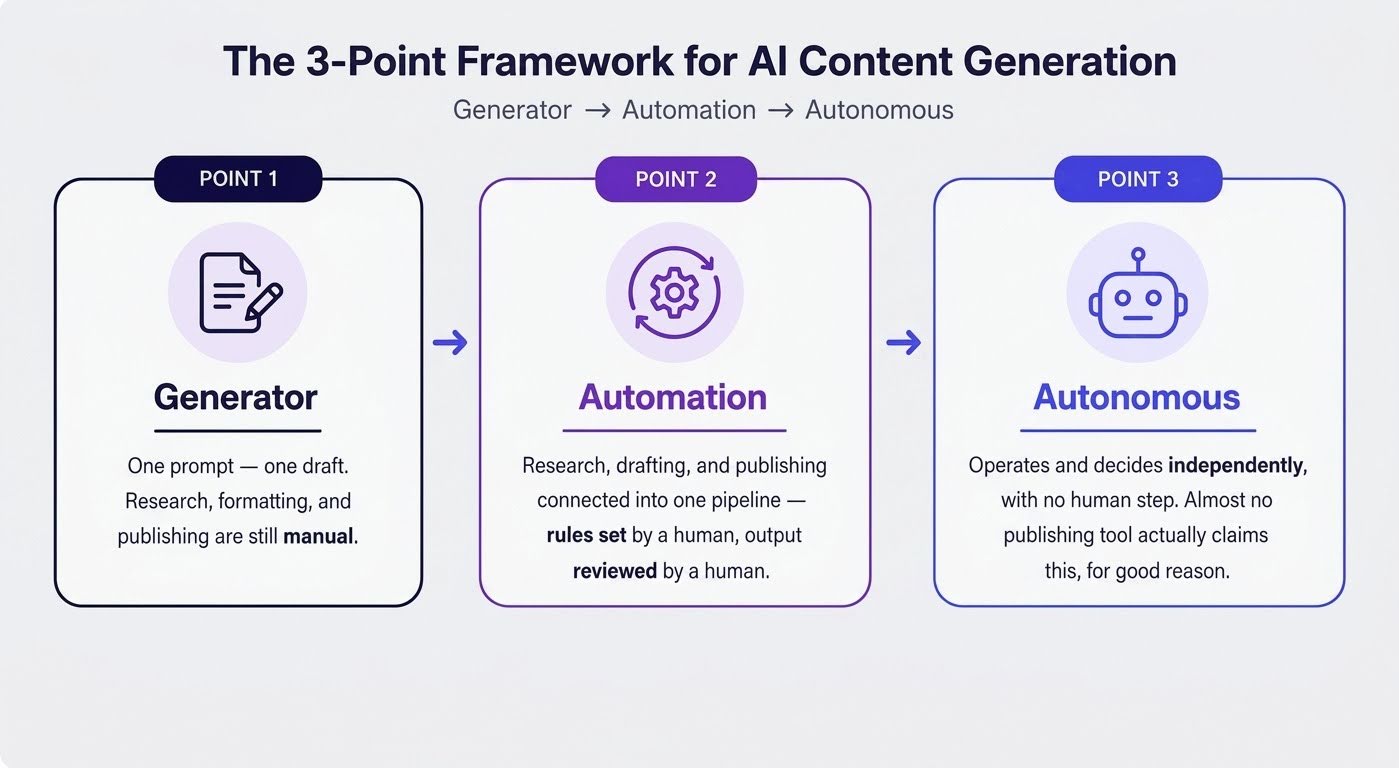
Based on the automation-vs-autonomy distinction described in Smartling’s guide to automated content generation.
Where Automation Actually Breaks
The failure mode isn’t AI writing badly at the sentence level; modern models are generally fluent. It’s what happens when automation runs without the layers meant to surround it.
A practical breakdown from automation workflow platform CodeWords describes the pattern clearly: teams adopt AI writing tools, generate far more volume than before, publish without meaningful editing, and then watch engagement metrics decline.
The root causes it identifies are a lack of a differentiation layer, so every competitor using the same model produces near-identical output; and a missing research phase, since language models can confabulate statistics and invent sources when nothing grounds the draft in real information.
Both problems trace back to the same root: automation was used to skip the research and editorial steps, not to strengthen them. That’s the opposite of what makes automation actually useful.
The pattern CodeWords describes
Publish-and-forget content that isn’t monitored for performance never improves. Automation without research and editorial oversight doesn’t remove the risk of bad content; it just makes bad content faster to produce.
Does Google Treat Automated Content Differently?
Google Search does not make “AI” the sole test for whether a page is acceptable. Its spam policies define scaled content abuse as producing many pages primarily to manipulate Search rankings rather than help users. Google explicitly notes that this can include generative AI, but the policy is about the purpose and quality of the content, not simply the fact that AI was used.
For that reason, no honest SEO shortcut exists where switching from a generator to an automation platform guarantees rankings. A responsible workflow should add research, fact-checking, useful original analysis, editing, and a clear reason for publishing each page.
Generator, Automation, or Autonomous: Side by Side
Here’s the same three-point spectrum laid out against what actually changes at each stage.
| Dimension | Generator | Automation | Autonomous |
|---|---|---|---|
| Input needed | A prompt, every time | Rules and topics set once | None, after setup |
| Research step | None, you supply the angle | Built into the pipeline | Built in, unchecked |
| Human review | Everything, by necessity | Final draft, by design | None, rare in practice |
| Output volume | Low, manual bottleneck | Steady, sustainable pace | Unlimited, unmonitored |
| Compliance checking | Usually manual | May be built into the workflow | Depends entirely on setup |
| Google policy risk | Depends on purpose and quality | Depends on purpose and quality | Higher if used for scaled, low-value output |
Compiled from the automation-vs-autonomy framing in Smartling’s guide and the failure patterns documented by CodeWords.
Where Edysor Sits on This Spectrum
According to the Edysor product information used for this article, Edysor is designed around a five-stage workflow: research, outline, write, illustrate, and publish. The documented workflow also describes compliance checks against configured banned claims and required disclaimers, plus review before publication by default.
Those are product claims rather than independent performance findings, so they should be understood as features described by Edysor, not guarantees of SEO results, factual accuracy, or publishing performance. As with any AI workflow, review the final output before relying on it or publishing it.
Starter
$29/month · 30 credits
One site, automation running at a sustainable pace, not volume for its own sake.
- 1 site
- Research-backed, 3,000–4,000 word posts
- Compliance guardrails and disclaimers
- Held for review by default
How to Make AI Content More Useful for a US Audience
For US readers, SEO should start with search intent and usefulness, not keyword repetition. Use the language your audience uses, answer the question directly, and add information that helps the reader decide. Google recommends anticipating the terms readers may search for while keeping the content helpful and people-first.
- Use a clear primary topic and a descriptive title.
- Answer the main search intent early instead of delaying the answer.
- Use natural US English and examples relevant to US businesses when the audience calls for them.
- Add original analysis, examples, comparisons, or product experience instead of rewriting what other pages already say.
- Fact-check statistics, product claims, dates, pricing, and policy statements before publication.
- Use descriptive internal-link anchor text and meaningful image alt text.
These practices are more durable than trying to hit an arbitrary keyword density. Google says its systems can understand related queries and recommends people-first content rather than search-engine-first writing.
Which One Do You Actually Need?
If you publish occasionally and have time to research and structure each post yourself, a plain generator can be enough; it’s a faster first draft, nothing more.
If blogging has become a resourcing problem rather than a writing problem — a backlog that keeps growing, several client sites that all need content, a schedule you can’t hit with manual writing alone — that’s the point where automation earns its cost. Not autonomy. Automation with a human still in the loop.
Frequently Asked Questions
Is AI content automation the same as autonomous AI publishing?
No. Automation means the creation, optimization, and reuse steps are connected into one pipeline, but a human still sets the rules and, in a well-built tool, still reviews the output. Autonomous means the system operates and decides independently, with no human step — a distinction Smartling draws explicitly in its own guidance.
Will Google penalize automated blog content?
Google’s scaled content abuse policy focuses on content produced at scale primarily to manipulate Search rankings rather than help users. AI or automation is not, by itself, the deciding factor. The content’s purpose, usefulness, originality, and compliance with Google’s spam policies matter.
What’s the actual risk of using a bare AI content generator?
A key risk is treating the generated draft as finished work. AI systems can produce incorrect facts or unsupported claims, so research and fact-checking are important. A consistent editorial process also helps prevent repetitive, generic content.
Does Edysor publish autonomously, or does it require review?
Review by default. Auto-publish is switched off unless you turn it on, and even then, a post that matches a banned claim from your industry profile is still forced to pending. Edysor sits on the automation end of the spectrum, not the autonomous one.
Conclusion: Automation Is a Bigger Job Than Generation
“AI content generator” and “AI content automation” aren’t interchangeable, even though marketing copy, including plenty of ours, often treats them that way. A generator produces text from a prompt. Automation connects research, drafting, optimization, and publishing into a system, with a human still setting the rules and reviewing the output.
Edysor was built to sit deliberately at that second point: a connected pipeline with compliance guardrails and human review by default — automation, not autonomy.
See what one credit produces
One credit is one finished post. Auto-publish stays off until you turn it on.
Sources and references
- Google Search Central — Creating helpful, reliable, people-first content
- Google Search Central — Spam policies for Google Search, including scaled content abuse
- Nota — What Is AI Content Automation? A Beginner’s Guide
- Smartling — Mastering automated content generation: Tools and best practices
- CodeWords — AI content automation: where it works and where it fails